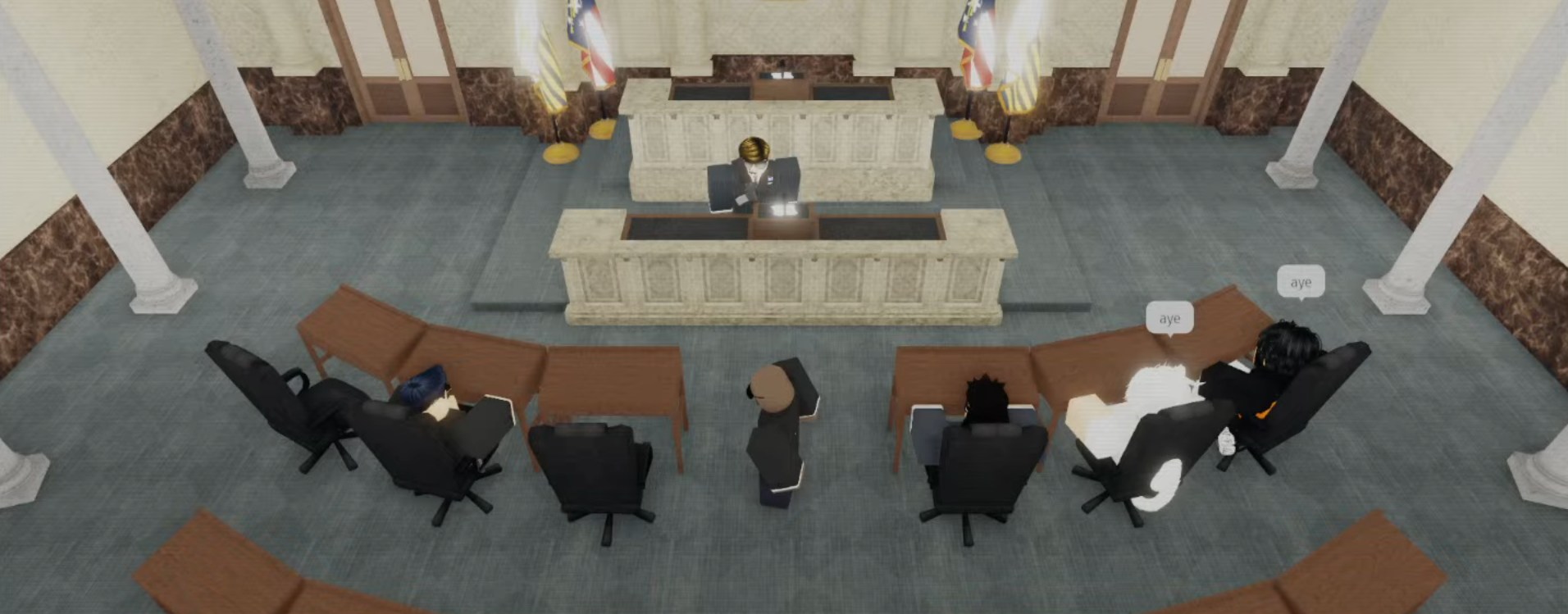

The 5th Congress of the Mayflower State Senate has conducted its last session before the upcoming elections this month. The Senate passed record amount of items, including 39 bills, 2 resolutions, and 6 nominations. It also failed 5 items, including 2 nominations, 1 bill, and 2 constitutional amendments.
Editors Note: Since the publication of this article, the Mayflower Electoral Commission (MEC) unexpectedly postponed the Class 2 Senate Elections.
Table of Contents
Passed Items
These are the items passed by the Mayflower State Senate. They can be viewed in their docket here.
Nominations
- SGN064 | BrendaPopplewell to serve as a Mayflower District Court Judge
- SGN071 | bob78711new to serve as a Magistrate Judge
- SGN073 | Ocazius to serve as a Magistrate Judge
- SGN085 | Singhski to serve as Chancellor of the Mayflower State University
- SGN074 | BlcVlCI to serve as a Magistrate Judge
- SGN081 | npz_v to serve as a Magistrate Judge
Bills
SB418 | Approach Structures Act
S.B. 418 defines “Approach Structures” as ramps, viaducts, or elevated roadways connecting local roads to bridges or highways, including related structural and safety elements like guardrails, lighting, and sidewalks. It establishes that any such structure directly connected to a State highway is part of the Highway System unless otherwise designated. The Secretary of Transportation is authorized to set technical and safety standards for these structures. The bill also makes it a misdemeanor to stop, park, or idle on an Approach Structure, except in emergencies or for law enforcement purposes.
SB419 | First-Degree Murder Clarification Act
S.B. 419 expands the definition of “Protected Person” to include employees of various government departments, public agencies, emergency services, healthcare entities, and licensed private security personnel who are identifiable and acting within their official duties. It amends state law so that killing a protected person while they are performing their duties qualifies as first-degree murder.
SB420 | NG Firearm Reference Clarification Act
This bill amends firearm possession laws to exempt Mayflower National Guardsmen from penalties for unlicensed firearm possession when carrying a pistol issued by the Guard, as long as it’s permitted under their department’s policies. It clarifies that Guardsmen may legally possess their issued sidearm even when off duty, provided departmental authorization exists.
SB421 | Succession Redundancy Amendment
S.B. 421 revises the definition of the “gubernatorial line of succession” to include only those public officers constitutionally allowed to assume the Governor’s duties if the Governor becomes incapacitated. It repeals all previous subsections and related provisions under 3 M.S.C. 1 § 1103, effectively streamlining and simplifying the state’s succession law.
SB422 | Remember Your Oath Act
S.B. 422, the Remember Your Oath Act, reorganizes state government responsibilities by making 3 M.S.C. 1 § 3206(b) inactive and redefining the State Department’s role as the chief clerk of state. The department will now manage museums, corporate registration, and the archiving of all oaths of office. It also designates the Secretary of State as the state’s chief diplomat, responsible for handling foreign affairs and communications on behalf of the Governor.
SB423 | Lawyered Up Legislature Act
S.B. 423 establishes the Office of Legal Counsel within the State Legislature to provide independent legal representation and advice to the Senate. The office, led by an appointed Senate Legal Counsel and Deputy Counsel, will defend the Senate, its members, and committees in official legal matters, including enforcing subpoenas and upholding legislative privileges and constitutional powers. Appointments are made without regard to political affiliation and require legal qualifications. The office may not handle personal lawsuits but will act to protect the Legislature’s authority, constitutional duties, and legal proceedings when directed by Senate resolution.
SB424 | Military Police Act
S.B. 424 authorizes the Mayflower National Guard to establish and designate units as Military Law Enforcement, granting them the same powers and privileges as Military Police. These units will operate under the supervision of the Command Group or another designated authority. The bill also classifies Military Police as Peace Officers of the State while on duty, giving them full law enforcement authority within their jurisdiction.
SB425 | Administrative Division Act
S.B. 425 creates the Administrative Division of the District Court of Mayflower, a new judicial body with exclusive authority to hear and decide cases involving government actions, inactions, or decisions. It defines key legal terms and establishes detailed procedures to ensure due process, transparency, and judicial independence in administrative disputes. The Division can issue injunctions, compel agency action, overturn unlawful decisions, and impose sanctions for bad faith or noncompliance. It also outlines clear appeal rights to the Supreme Court, strict compliance enforcement mechanisms for government entities, and protections for whistleblowers. Finally, the bill adds a Judicial Transparency Clause, mandating that all judicial disciplinary proceedings be public, recorded, and monitored by a newly empowered Marshal of the Supreme Court to guarantee fairness and accountability.
SB426 | Mums Word Act
S.B. 426 establishes a new subchapter in state law titled “Administration of Oaths”, granting formal authority to Senate officials to administer oaths and affirmations. The bill empowers the Presiding Officer of the Senate, as well as any committee or subcommittee, to administer oaths related to matters within the Senate’s jurisdiction. It also authorizes the Sergeant-at-Arms and their assistants to administer oaths to Senate officers and witnesses appearing before the Senate, ensuring lawful and accountable proceedings.
SB427 | Protective Training Act
S.B. 427, the Protective Training Act, authorizes State Protective Service Coordinators to temporarily become protectees of the State Police for training and skill development purposes, with the Colonel’s consent. It grants the State Police full protective authority during such assignments, ensuring legal protection for their actions. The bill also allows joint training exercises with the National Guard and other government agencies, provided the Governor consents, extending the same protective rights to all participating entities.
SB428 | Give Me Juries or Give Me Death Act
S.B. 428, titled the “Give Me Juries” Act, establishes the requirement of a capital jury for any case involving the death penalty in Mayflower. It mandates that no court may impose or sign a death sentence without a unanimous recommendation from a six-member jury after considering all mitigating and aggravating factors. The bill sets detailed procedures for jury selection, ensuring jurors are randomly chosen, qualified residents, and screened for impartiality regarding the death penalty. It also prohibits discrimination in jury selection based on ethnicity, gender, religion, or residency length, and amends state law to specify that individuals sentenced to death by a jury shall be placed in the custody of the Attorney General through the State Police.
SB429 | Department of the Treasury Act
S.B. 429 establishes the Department of the Treasury, led by a Secretary appointed by the Governor and a Treasurer appointed by the Community Administrator, to manage all state funds, audits, and financial reporting. It reorganizes the state’s budget framework, creating new subchapters for appropriations and enforcement. The bill sets strict financial accountability rules for agencies, mandates transparent recordkeeping, and criminalizes the misappropriation of state funds. All prior state budget allocations are repealed under this act.
SB430 | The Wartime Security Act
S.B. 430 (The Bisons Act) expands wartime powers by allowing the Governor to deport foreign high officials from enemy nations and restrict their access to sensitive areas. It authorizes the National Guard to use lethal force against hostile or trespassing individuals during war and criminalizes the unauthorized sharing of military information or media. The bill amends state law to classify such disclosures as a felony under “Unauthorized Distribution of Classified Information.”
SB431 | Track My Orders Act
S.B. 431 (Track My Orders Act) requires the Attorney General to maintain a public database of all memorandums, directives, and orders issued by them or the Justice Department. The database must include the author, title, subject, legal authority, and issue date of each document, except those containing state secrets or privileged information.
SB432 | Required Security Act
S.B. 432 requires businesses that conduct in-game gambling to employ security guards to protect their property and customers. While constant security presence isn’t mandatory, customers must be able to request security assistance when needed.
SB433 | Praetorian Prevention Amendment
S.B. 433 amends the duties of the Mayflower National Guard to explicitly include protecting the Governor during emergencies, wartime, or when accompanied by State Police, as well as any other officials designated by the Governor, while rendering a previous provision inactive.
SB434 | Dont Touch My Officials Act
S.B. 434 establishes strict criminal penalties to protect elected officials and the State Capitol. It makes assassination or hostage-taking of elected officials felonies with prison sentences of 65 and 50 minutes, respectively, and criminalizes discharging firearms or destructive devices on Capitol grounds, with penalties ranging from 30 to 60 minutes.
SB435 | FOIA Specificity Amendment
S.B. 435 updates the FOIA framework in Mayflower by clarifying definitions for “State Agency” and “FOIA requester,” allowing agencies to deny overly broad requests, and requiring redaction—not deletion—of classified or exempt information. It establishes clear procedures for partial disclosures, exemptions, and provides a 24-hour court petition process for noncompliance, while allowing requesters to challenge improper exemptions.
SB436 | Im Just Part Time Act
S.B. 436 establishes the “Im Just Part Time Act,” defining primary and auxiliary positions within state agencies. It presumes roles are primary unless specified otherwise and ensures auxiliary positions are not subject to the same quotas or activity requirements as primary positions.
SB437 | Performance Review Act
S.B. 437 establishes the “Performance Review Act,” requiring written evaluations of employees against job standards, with notice of results. Employees who fail to meet standards receive a performance plan with clear deficiencies, measurable objectives, and a minimum 14-day timeline for improvement. Continued failure may result in discharge, and all reviews and plans must be retained in the personnel file and accessible to the employee.
SB438 | The Committee Freedom Amendment
S.B. 438 amends reporting requirements, mandating that the Mayflower Bureau of Investigation notify the relevant Senate Committee or Senate-at-Large before executing certain actions. It also requires that any use of explosive devices causing damage or non-combatant casualties be documented and submitted to the Adjutant General for review by the designated Senate Committee, the Legislature, or a court.
SB439 | Mobilize The Guard Act
S.B. 439 establishes a “Military Reporting and Oversight” chapter requiring the Governor to notify the State Legislature—or a designated Senate Committee—about National Guard and Special Forces deployments during peacetime, including authority, reason, duration, and units involved. After deployment, the Governor must provide a summary, timeline, operational takeaways, and any needed legislative support. Additionally, the State Legislature or its committee must be informed of all foreign intelligence operations conducted by the State.
SB440 | State Archives Act
S.B. 440 establishes the Office of State Archives under the Secretary of State to maintain public records of governors’ works, speeches, pardons, awards, and oaths of office. Outgoing governors must transfer all official records within 30 days, with a two-month temporary restriction allowed for classified material. Records are automatically declassified three months after leaving office, except for state defense or confidential source information. Failure to transfer records timely can result in criminal prosecution for gross misconduct.
SB441 | Task Force Permittance Act
S.B. 441 authorizes the Attorney General to create interagency task forces for law enforcement, public safety, or justice purposes. These task forces can coordinate investigations, enforce laws, share intelligence, and develop policies, with participating departments required to provide personnel and support. The Attorney General sets operational rules and reporting requirements, but National Guard involvement requires legislative approval.
SB442 | Intelligence Accountability Act
S.B. 442 establishes the “Intelligence Accountability” chapter, requiring the Governor, Director of State Intelligence, and heads of all relevant agencies to keep the State Legislature or designated Senate Committees fully informed of all intelligence activities, failures, and domestic operations. It mandates regular reporting on security clearances, certifications of compliance every four months, and written reports on significant intelligence activities or failures. The act also sets procedures to protect classified information while ensuring legislative oversight and explicitly prohibits intelligence operations aimed at influencing the State of Mayflower’s political processes or public opinion.
SB443 | Another Congressional Contempt Act
S.B. 443 allows the Senate or its committees to hold individuals in contempt if they fail to comply with subpoenas, orders, or obstruct legislative proceedings. The Senate may set a reasonable punishment under the Mayflower Criminal Code and, if criminal action is warranted, refer the matter to the Department of Justice. Contemnors must be given notice of the allegations and evidence before any finding of contempt.
SB444 | Military Briefings Act
S.B. 444 establishes “Guard Oversight and Accountability,” requiring the Governor to notify the designated Senate Standing Committee about National Guard deployments. Notifications must occur within six hours of domestic deployments and one hour after their conclusion, with detailed briefings to follow within three days. Briefings must cover legal basis, objectives, scope, duration, activities, efficiency, engagement with opposing forces, use of lethal force, and any additional assistance needed.
SB445 | Fun With Fireworks Act
S.B. 445 (“Fun with Fireworks Act”) allows municipal law enforcement heads to regulate fireworks within their jurisdiction, with no outdoor restrictions on state holidays. Fireworks are prohibited on the State Capitol grounds or indoors on public property. Violations are punishable as follows: discharging fireworks on protected property is a misdemeanor with a 10-minute prison term and $3,500 fine, while violating municipal firework regulations is an infraction with a $1,500 fine.
SB446 | Street Gangs Enabling Act
S.B. 446 amends definitions and procedures regarding criminal street gangs and terrorism designations. It updates the definition of a criminal street gang, allows law enforcement and National Guard members with authorization to conduct controlled burns on vehicles used by gangs or in attacks on Military Exclusion Zones, and requires Attorney General or Bureau approval for such actions. Additionally, terrorist or state-sponsored terrorist designations now last no more than 14 days and must be reviewed before renewal.
SB447 | The Stop Trafficking Act
S.B. 447 establishes extraterritorial jurisdiction over trafficking crimes. It makes it a felony to deprive anyone, including elected officials, of their personal liberty and transport them across state or federal borders, with penalties of 50 minutes for general trafficking and 100 minutes for elected officials. Crimes committed during such trafficking, including grievous bodily harm or death, are treated as if committed within Mayflower.
SB448 | Office of State Intelligence Act
S.B. 448 establishes the Office of State Intelligence (OSI) as a cabinet-level agency in Mayflower. The Governor appoints a Director, who oversees intelligence, counterintelligence, interagency coordination, and security clearance management, with full access to state agencies’ intelligence and investigative data. OSI includes oversight, compliance, data integrity, interagency training, and a confidential advisory council, with reporting requirements to the Governor and Legislature. The act also grants OSI authority over classification, security clearances, and enforces strict penalties for unauthorized handling or obstruction of intelligence activities.
SB449 | Administrative Action Amendment Act
S.B. 449 amends 4 M.S.C. 7 § 1301 to limit the employment bar resulting from a dishonorable discharge to a maximum of two months from the date of issuance.
SB450 | The Misconduct Act
S.B. 450 updates 1 M.S.C. § 1302 by increasing penalties for misconduct.
SB451 | The Lobbying Act
S.B. 451 establishes lobbying regulations in the Mayflower State Code, requiring Senators to document all contributions and expenditures, particularly those of $10,000 or more. Lobbyists must register with the Secretary of the Senate before attempting to influence legislation and submit quarterly reports detailing funds received, spent, and related activities. Journalists, public officials, and individuals merely appearing before committees are exempt from these reporting requirements. Violations of the chapter can result in prosecution under 1 M.S.C. § 1103 and other applicable laws.
SB452 | Protect The Whistleblowers Act
S.B. 452 amends 4 M.S.C. 5 § 5207 to prohibit State Agencies and officials from requiring waivers or nondisclosure agreements that restrict whistleblower protections. It mandates that all State Agencies implement policies safeguarding employees who engage in whistleblowing. This ensures that employees can report misconduct without fear of retaliation or employment consequences. The law strengthens transparency and accountability within state operations.
SB453 | Aviation Safety Amendment
S.B. 453 repeals the provisions of Title 6, Subtitle 6, Chapter II, Subchapter VI, allowing the Mayflower Aviation Authority from maintaining a registry of aircraft tail numbers.
SB454 | The 2002 Budget Allocation Act
S.B. 454 sets specific staffing limits for law enforcement agencies across Mayflower, capping municipal, county, state, and port police forces at defined numbers. The City of Lander and other municipalities hosting the Senate are limited to 150 municipal employees, while other municipalities may employ up to 145. County agencies are capped at 175, the State Police at 180, and the Port Authority and Quanahassit Police at 75 employees. This amendment standardizes personnel limits to regulate law enforcement staffing statewide.
SB455 | Motor Vehicle Investigator Act
S.B. 455 establishes the DMV Office of Field Investigation (OFI) as a subdivision of the Mayflower Transportation Police under the exclusive authority of the DMV Commissioner. The OFI is responsible for enforcing DMV laws, regulations, and permits, with Motor Vehicle Investigators (MVIs) empowered to conduct inspections, issue citations, and temporarily detain individuals when necessary. MVIs remain civilian personnel without general peace officer authority, though assigned sworn officers retain full law enforcement powers while also exercising OFI-specific authority. The act also limits the OFI to ten MVIs, establishes Special Equipment Inspections, and ensures administrative support from the Mayflower Transportation Police without granting operational control.
SB456 | more ccso protections
Extends county protections to the County Executive, the District Attorney, and County Sheriff.
Resolutions
SR128 | A Resolution to Excuse the Absence of Senators
S.R. 128 is a resolution by the Senate excusing the absences of six senators—kenneytube, sudonull, AnakinT0ast, Otamaleh, springykfc, and Just_Dapper—due to no in-game legislative session being held for the past 30 days. The resolution explicitly prevents these senators from being expelled from office for the period of their absence.
SR129 | A Resolution to Solicit an Opinion on Session Attendance
S.R. 129 is a Senate resolution formally requesting the opinion of the Supreme Court of the State of Mayflower regarding the interpretation of the Constitution’s attendance requirement for senators. Specifically, it asks whether attending a legislative session held “over discord” counts as fulfilling the constitutional mandate, or if only attendance at official in-game sessions is recognized. This inquiry is made under the authority granted by Article X, Section 9 of the state Constitution.
Failed Items
These are the items failed by the Mayflower State Senate. They can be viewed in their docket here.
Nominations
- SGN078 | Nomadity to serve as Associate Justice of the Mayflower Supreme Court
- SGN084 | actxrz to serve as Director-General of the Mayflower Public Broadcasting Service
Bills
SB417 | Mayflower Bridge Fishing License Act
S.B. 417 establishes regulations for bridge fishing in the State of Mayflower by defining a new “bridge fishing license” and specifying its use. It requires anyone fishing on or near a bridge to hold either a regular fishing license, a bridge fishing license, or be employed by a business with a commercial fishing license. Conservation officers are granted authority to verify licenses and, with reasonable grounds, conduct limited searches of individuals and their vehicles when observing fishing activity. Violating the bridge fishing license requirement constitutes an infraction under the Mayflower State Code.
Resolutions
SR108 | Amendment to Article I, Section V
S.R. 108 proposes an amendment to Article I, Section 5 of the Mayflower State Constitution to guarantee that any individual facing the death penalty has the right to a trial by an impartial jury. The resolution allows the State Legislature to extend the right to a trial by jury in other cases. It also mandates that the Legislature establish the procedures for summoning, selecting, and conducting a jury. This ensures that capital cases are adjudicated with the protections of a fair and unbiased jury process.
SR114 | Article VI, Section 3 Constitutional Amendment
S.R. 114 proposes an amendment to Article VI, Section 3 of the Mayflower Constitution to enhance legislative oversight of the Attorney General. It removes the requirement for the Governor’s consent to reverse an Attorney General directive, increasing accountability within the Executive Branch. The amendment clarifies that directives issued by the Attorney General must enforce the law, maintain ethical practices, and protect state safety. It also grants the Legislature the authority, by resolution, to strike any directive or order it deems unjust or unconstitutional.

 THIS WEEK'S TOP STORIES